12/10/2007

The Electrician

As the oldest of 6, the mother of 4, I have always been fascinated by children's individual differences. Anne and I have been speculating about what kind of a child Michael will be since he was born. She was an explorer, walking and climbing stairs at 9 months, walking up to early large dog in Central Park at 1, mastering slides, climbing structures, ice skating, cartwheels, head stands much earlier than her friends. However, she never showed any interest in electric outlets.

My youngest, Carolyn, resembled Anne, but was considerably more ambitious. She crawled before she was 5 months; delighted to pull herself up to a stand leaning on our kitten. She needed three sets of stitches on her face before she was 2 because she always ran in a small house, colliding with stairs, pianos, and coffee tables. Michelle and Rose, my middle daughters, required entire different childproofing, because they had far more advanced small motor skills, so knobs came off stoves, electric outlets were barricades, cabinets had more complicated locks.

At 7 months, Michael clearly has the small motor skills of Michelle and Rose. I hope he is less challenging because he doesn't have older siblings unchildproofing as fast as I could childproof. Michelle loved to make "potions"; I dreaded a phone call to poison control explaining that the baby had drunk a liquid containing bees, dandelions, contact lens solution, detergent, desitin, chocolate, yogurt, perfume.

Childproofing is considerably easier in a 2-bedroom apartment than a 2-story house, except for the terrace on the sixth floor. Michael is clearly demonstrating the persistence and determination all my daughters showed in their different ways,Posted by Picasa

12/09/2007

Captivity

I have discovered how to keep  my grad son Michael in temporary captivity. He seems content to sit in a box with a sufficiently absorbing toy, like an old remote control without batteries. This has made it possible for me to pee. I just bring the box into the bathroom and plop him in it. If his mommy or daddy tried it while taking a shower, they would probably find him sitting in the kitty litter.

12/06/2007

Mischief

Grandma hasn't noticed I am chewing on the spiral
Where did the shoes go?

I know the electric outlet is here somewhere

Newspaper, my favorite snackPosted by Picasa

Object Permanence---Michael and the Cats

Since Michael learned to crawl proficiently, his constant goal is the cat food outside the bathroom. I've hauled him away from it dozens of times. I decided to try another strategy. I covered the food and water with two box covers. Nate couldn't figure out where they had gone and turned around and chased the cat. The cats knew very well it must be there, but could not figure out how to take off the covers. Michael could have gotten them off immediately if he realized what they concealed. I am grateful Michael and the cats don't collaborate.
Posted by Picasa

11/30/2007

Homework: A Rant

For the first six years of grade school, my oldest daughter went to schools in Manhattan and Maine that did not give homework except for some long-term reading expectations. At the time I didn't sufficiently appreciate how lovely and stress free after-school time was.

11/29/2007

Michael's Favorite Things

As the video shows, Nate has mastered sitting up by himself and crawling. Sometimes, he still prefers to creep when he is in a hurry to get something we might decide to take away from him.

I believe in giving crawlers and toddlers maximum freedom to explore that is compatible with safety. Unfortunately, safety in the studio means constantly distracting him every three minutes. Absolutely everything Michael encounters, he puts in his mouth. Here some of the things he loves best:

  • Crawling under the bed and eating shoes and shoelaces
  • Crawling under the bed and tearing up the New York Times and the most current issues of his daddy's favorite magazines
  • The cat scratching post
  • Anything that lights up
  • Lamps
  • Cell phones. He has quickly discovered that the dead one without batteries that I gave him is a fake.
  • Remote controls. Vanessa said he tried to eat one as if it were a hamburger.
  • Computers. He recognizes the throne of power.
  • All electric cords
  • Paint cans
  • Plastic bags
  • My cane
  • Handbags and backpacks
  • Zippers
  • Velcro
  • Cameras and camcorders
  • All paper
  • Glasses

Crawling

This is a short video of Nate crawling. I can't take a long video because I invariably have to distract him from something dangerous/inedible. I am looking forward to the new apartment as much as Vanessa and John. I took him down to the new apartment to crawl around an empty room and he was primarily interested in the electric sockets.

11/27/2007

Sharing a Room

Emily at Wheels on the Bus had an excellent post today on children's sharing rooms. Since I had a 2-bedroom apartment, a 3-bedroom apartment, and then a 3-bedroom house, my 4 daughters always shared rooms until the older ones went to college and shared rooms with absolute strangers.

Growing up, I was the only girl with 5 younger brothers; from the time I was 7, I had my own room. Before that, I shared a bedroom with my 2 younger brothers. I always wanted a sister, and I would have been happy to share a room with her. I always had roommates in college and in my first Manhattan apartments before I got married. My husband came from a family of 5 kids, and he always shared a room with his brother.

We took it for granted that our kids would share bedrooms. Originally we planned to stay in a New York City apartment, and only millionaires have a big enough apartment to give each of 4 children their own room. In no way did we ever feel we were depriving our kids because they didn't have their own rooms. In our 3-bedroom Manhattan apartment, 3 of them decided to sleep in the same bedroom, so they could use the extra bedroom as a playroom.

Getting the baby out of our bedroom was much easier because she looked forward to sharing a room with her sisters. Sharing bedrooms made bedtime easier all through early childhood.
I suspect my girls are closer because of their enforced togetherness. Sure there were conflicts, especially over cleaning rooms. I do recall my second child putting a strip of duct tape down the center of the room to establish cleaning responsibilities. Possibly they played more outside their bedrooms since they had less room.

Sharing rooms is excellent preparation for college. My kids always had roommates in college in dorm rooms much smaller than the usual bedroom. At Yale, one year, they had to share bunkbeds. In major US cities, most people share apartments for economic reasons.

I am 62. I only had my own room for 16 years--11 years of my childhood and 5 years between marriages. I have never felt deprived:)

11/20/2007

I Like to Feed Myself

Posted by Picasa
Michael seems to like rice cereal sweetened with breast milk better than unsweetened applesauce. Given how sweet breast milk is, unsweetened food might be too much of a shock. He doesn't necessarily swallow any of the cereal, but he doesn't make faces. He seems to enjoy playing with the spoon best of all.

11/19/2007

Discipline--Grandmothers and Mothers

Reading other mothers’ blogs, I am feeling all of my 63 years and every strand of my silver hair. Although I might feel more comfortable with these eloquent younger women, I belong to their mothers’ generation and might symbolize for them their mothers’ mistakes. I was born a month before the end of World War II. I am six months too old to be a baby boomer. Most of my contemporaries didn’t stay home with their kids, didn’t have 4 children, and pitied me for my domestic imprisonment.

I was often surprised by how much stricter some of the blogging mothers seem to be. My oldest daughter, 35, speculated that her generation believed more in discipline than their parents did, because so many of their parents worked long hours and used permissiveness to assuage their guilt about their unavailability to their kids. Do you think she has a point? Or does the economic necessity of entrusting children to group or nanny care at younger ages demand better behavior than parents who stay at home would expect or tolerate?

My four daughters were not model children. I was better at stimulation and creativity than boundaries and discipline. They were excellent students when they showed up in school. In retrospect, I permitted an overly permissive ad hoc homeschooling option for the easily bored who could cough convincingly. They did not speak to their grandparents, teachers, any other adults the way they were allowed to speak to their parents. I often heard about my charming, delightful daughters.

I wonder if today’s moms would let their kids play with my kids. My kids were allowed to express their feelings endlessly. They rarely picked up their toys and their rooms were unspeakable. Chronically late, they often needed to be driven to a that was close enough to walk to. Household chores were not their strong points. No doubt I was rebelling against the strict, guilt-inducing discipline of my Catholic childhood. I transferred my first daughter to another public school because her teacher said "for shame" to her on the second day of kindergarten.

I was not permissive about violence. I always stopped my oldest daughter from hitting her younger sister. She was only 2; I didn't punish her. But I made a big deal of encouraging her to express her anger in words. "Use words not hitting to tell Michelle how you feel." Anne dictated stories and drew pictures to express how she felt about her sister. The books were simple affairs. I folded construction paper, used a hole puncher on the fold, and tied the sheets together with string. I kept them, and everyone still loves to read them. I always took away the toy used as a weapon. By the time Anne was 4 and Michelle was 2, they usually could play happily with blocks without mayhem.

Punishment would not have taught Anne a lifelong way of handling her anger; it would have just made her more rebellious. I hurt my back when she was 3 and could not play with her as usual. "Draw me a picture of the dummy mommy with the bad back," she instructed. She then took a pencil and stabbed that picture countless times. I was appalled, but it helped her. Anne had almost perfect recall of her dreams from the time she was 2. Their violence was a revelation. "Daddy went under the train last night because I didn't like his noise. Then I went to live with Ellen." "But Ellen sometimes yells at her children," I pointed out. "Then she will have to go under the train too," Anne said matter of factly. Now Ann works for a world peace organization.

My two younger daughters were relatively peaceful creatures who were born using words not weapons. Carolyn, the baby, was babbling once her head was born. Their older sisters adored them. I attributed such harmony to the sibling bonding that occurred when Rose and Carolyn were born at home. Three and one half years apart rather than 2 years apart make a tremendous difference. Rose, my third daughter, would remind me that toddler Carolyn sometimes bit her without provocation, and Rose, a wonderful big sister, never responded in kind.

Disciplining them for verbal aggression would have been a full-time job. Their father and I were not perfect role models. When I was 7 years old and made my first confession, my sins were: disobedience, talking back to my parents, and hitting my brothers. In succeeding years, despite frequent repentance, I managed to stop hitting my brothers, but made little progress on the other two sins. We tolerated our daughters talking back to us if they were not abusive. "I hate you mommy" was acceptable if they could articulate their anger more specifically. I admit “respect” was not a word they heard frequently.

My younger daughter’s daughter's college application essay gives an evaluation of my discipline style I don’t deserve: "We were never spanked or severely punished when we did something Mom disapproved of. Instead, she simply told us how she felt about it. I'm sure some parents would say that my sisters and I weren't disciplined enough. However, I've noticed that when friends of mine are grounded, they often complain about their unfair parents, but I take it very seriously when Mom tells me she's disappointed in me. “ She charitably left out all the times I let them behave in a way I found intolerable and then I screamed at them. Obviously it would have been better to respect my limits and save them from my harsh words.

We were strict about academics, safety, and seatbelts. Dropping out of honors classes or not taking advancement placement courses because they required too much work was never acceptable. Possibly we pressured them too much to succeed academically, but we expected them to honor their considerable intellectual gifts. We threw out our television set when our oldest was four and didn’t get another for five years. We were extremely strict about TV; we had a lock on it. They could not watch TV on school nights. We rejoiced that we had the only teenagers who felt they were being bad by watching TV. There were no problems with boys, booze, or drugs. We were relatively poor, so we didn't buy them lots of clothes or toys. We encouraged their interest in world affairs, occasionally took them to peace demonstrations.

I made countless mistakes, but they all are well-educated, compassionate, dedicated women, able to own and use all their particular gifts. They have met and married wonderful men. They assure me they are going to be much stricter with their kids and make them clean up their room, vacuum, mop, clean bathrooms and go to school every single day they are not running a 103 fever. We all try not to repeat our parents' mistakes, possibly then making our grandparents' mistakes. We might only learn the truth about our parenting by watching our children parent our grandchildren. My oldest daughter is a far better mother than I was with her, but my first grandson is only 15 months old. Anne and Michael are an excellent match. When people tell me he is all boy, I always demur, saying he is all his mother. Anne was much more like my mother than she was like me. Sometimes I felt squashed between two very powerful, dominant personalities.

Gardening


Gardening is in my blood. My grandparents had World War II victory gardens. My parents had a big backyard, about a third of an acre. My dad was a vegetable gardener, my mom grew flowers. Neither of them were great cooks, so I don't remember specific family recipes. What I remember are delicious fresh vegetables--tomatoes, string beans, corn, zucchini, broccoli, lettuce. No tomatoes or corn have ever tasted as good. They had wonderful blueberries bushes, which supplied enough berries to freeze for winter cereal. Before my mom went back to college, she canned tomatoes.

Gardening was the perfect way for my dad to unwind from his actuarial job and his long railroad commute into Manhattan. I remember his encouraging us to start our own little gardens. I remember helping him plant strawberries. I remember picking off Japanese beetles from the rose bushes and putting them in a jar of something that killed them. The garden was the best place for long talks with dad, away from the noise of too many brothers in a too small house.

After we moved to Long Island in 1983, I slowly became a gardener. I am erratic. I like to garden in the spring and fall before the summer heat drains my energy and motivation. I plant more than I weed. I usually grow herbs, tomatoes, cucumbers, zucchini, and eggplant. We have lots of perennials in the front yard; zinnias seem the ideal summer annual. Pruning and cutting the grass was an ideal way to deal with my anger in the years when my first marriage was dying. Visiting the garden first thing in the morning energizes me. Weeding is good for depression.

Since I became a grandmother, nurturing my grandson has replaced gardening. I look forward to introducing Michael to gardening when he is two and telling him stories about the great-grandparents he never met.

I Prefer the Taste of Haddock (Captain)


For some perspective, read what I wrote about Katherine's first reaction to solids at 6 months. "We've introduced solids, but Katherine doesn't seem terribly interested. She likes the plate and spoon to play with, but she dislikes our feeding her. She makes faces at the banana, then spits it out. I would assume she won't get very much until she learns to feed herself with some proficiency. She seems to like rice cereal and applesauce the best, but I doubt if she gets much in her mouth."

At 7 months: "Katherine spent about 1/2 hour trying to feed herself applesauce with a spoon. She was surprisingly successful at getting the spoon in her mouth." A week later: "Katherine fed herself a banana with the usual incredible mess. She is adamant about feeding herself."

11/18/2007

Best Toys


As my grandson, now five months, begins to play with toys, I have been thinking about toys and children. As the pictures show, blocks are my favorite. We had a huge collection; I have saved them for my grandchildren. Blocks were great for sibling sharing; they were everyone's toys. My recommendations:
books
blocks
indoor slide or climbing toy
outdoor climbing structure
water
bubbles
musical instruments
sand
pets
cooking, baking
gardening even if only on windowsill
endless art supplies
classic music, ballet music
lots of pieces of one and only one building toy; we have legos
dressup clothes, scarves, etc.-
dolls, stuffed animals, little people for use with lego and blocks
as much time as possible outdoors--gardens, backyards, parks, playgrounds, zoos, beaches, trees puddles, flowers, weeds, grass, birds, bugs, worms, etc.
New York City

I don't recommend toys with batteries or computer chips for babies and toddlers. They need to learn the real world before the virtual world. Ideally, kids before two shouldn't watch TV or dvds or play with computers. After two, children should only watch when interacting with parents and caregivers. Try to resist the temptation to plop your baby in front of the TV. She would be better off banging pots in the kitchen. She would be better off helping you clean the bathroom or do the laundry. We didn't have a TV set from 1977 to 1983 and I never regretted it.

11/17/2007

August 1976--Feminism and Motherhood

Reading my 1970's journals is both fascinating and disquieting. Do I still know this woman? Would I make friends with her? Would I read her blog? My present husband admits he would have been terrified to talk to her. Part of my confusion is rooted in the times I grew up, in the 1950s and early 1960s, long before feminism. If my oldest daughter Anne had 5 brothers, she wouldn't have received such contradictory messages on achievement and motherhood. All my siblings believe I deserved my struggles with Anne, since I gave my mom such a hard time:) I vividly remember my brother Andrew saying to me right after Anne was born: "Good, you have a daughter to fight with. That must make you very happy."

8/31/76 Since I started journaling, I had many insights into my difficulty in choosing a career. It's intimately bound up with my family, being the only girl with 5 younger bothers. The roots go back a generation; my mother had 5 younger brothers plus a sister she never had very much to do with. In the jargon of early feminism, we were both "male-identified." As a girl, I was very close to my 5 young uncles.

My mom was a tender, attentive mother who adored little children and managed them beautifully. How could I have not wanted to be like her--beautiful, vivacious, outgoing, loving, warm, playful. But I was nothing like her; I was shy, quiet, introverted, likely to be ignored in a crowded classroom. I always preferred reading to socializing. I always struggled with my belief that my mom wanted a daughter who was more like her rather than like my quiet, introverted, mathematician dad. I enjoyed babysitting; I never regretted being the oldest in a large family. As a child and early adolescent, I adored babies. My uncle had twins when I was 12. I often visited and helped them out, and tormented by mom by hoping that her sixth child would be twins. I frequently took care of my younger brothers when they were babies and toddlers.

Everything changed when I started high school and started to get attention for being smart. Early in high school I rejected my mother's world and chose my father's world. But even when my father agreed with me intellectually, he never supported me in my arguments with my mother; instead he blamed me for getting her upset. After my first daughter Anne was born, my dad told me he preferred wise women to intellectual ones. So I rejected my mother's world, yet I was close to my mother and dependent upon her. No wonder we were constantly fighting. What did my mother symbolize to me? Mindless maternity. A good mind going down the drain with the millions of dishes washed, the millions of diapers rinsed.

I perceived her as a good mother of young children, if not of troubled adolescents because she accepted things, did not probe, question, challenge the way things were. She found it easier to put others before self because she did not have a highly developed sense of self. I on the other hand was selfish and immature, putting my own intellectual development above all else. I clearly saw a dichotomy--wife and mother versus intellectual. No woman I had ever personally encountered had combined both. In fact, the nuns were the only career women I knew. All my aunts, mothers of my friends, the neighbors were housewives. I was in the process of rejecting Catholicism, so I never got close to any nun for her to serve as a role model. I began to suspect I never would get married, that the only way to attract a man was to play dumb, something I would never consider. I wasn't really rejecting motherhood; I never thought much about it. But when my first boyfriend wanted to tease me, all he had to say was that I was like my mother. I couldn't imagine anything more insulting.

I always sought out situations where I could be the only woman in a group of men. I didn't want to seduce them; I wanted to excel them. I made the mistake of going to a Catholic women's college my freshman year, Nazareth College of Rochester, because they offered the most scholarship money. Almost immediately I wanted to transfer. I told my parents I wanted to switch my major from English to Political Science, and Nazareth had no such department. I was only interested in college debate after the assistant dean explained that Nazareth had no debate club because "there's something in the nature of a woman that makes it objectionable for her to compete so openly with men." At Fordham I was usually the only girl in my political science classes. At Stanford, there was only one other woman among the first year grad students. I was positively crushed when I realized how many women there were at Columbia Law School.

It wasn't enough for me to think like a man; I had to think better than a man. I only made friends with women who had also rejected the conventions of femininity.


Everyone in the family perceived my dad as smarter than my mom, even her. She would always send us to him for the hard math and science homework. We were amazed when she returned to college and got all A's. And the mother who graduated form college in 1967 and grad school in 1968 and taught high school history was a different mother than the one I knew growing up. Looking back, I see my mother's ambivalence. My evident influence over her, that fact that she went to college when her youngest entered school, how hard she worked as a student and a teacher, her still emerging feminism all suggest she might have been giving me contradictory messages. Unquestionably, she identified with my opportunity to go away to college, my getting a NYC apartment, my opportunity to get a PhD all expenses paid--such chances were unheard of among her friends when she was my age. When I told her I was dropping out of Stanford and marrying John, she attempted to dissuade me. She never attempted to convince me to have a baby before I was ready to have one. Her reluctance to pressure me seemed to indicate that she would have done the same thing if circumstances were different. I was destined to go beyond her wildest dreams, and she would be very happy for me. Throughout my adolescence and young adulthood, the "masculine" intellectual, achieving, ambitious, competitive side of my personalty was nourished and encouraged by everybody.

So many of my school and career problems are unquestionably related to my constant striving to be a man, to deny my womanhood. That's why I am only discovering child development as a possible career. Any career involving children was feminine and therefore unworthy of my superior intellect. It was against all my principles and preconceptions to feel overwhelmingly maternal toward Anne. I thought the maternal instinct was a myth and suddenly I was wallowing in it. I suddenly understood had my mother could have decided to have six children. I still cannot understand how I suppressed the woman who can't pass a baby stroller without smiling and flirting with the baby, whose favorite section in bookstores if child care and children's books, whose favorite stores sell infant and toddler clothes. When all that arose to me, what had been thoroughly buried for at least 15 years, no wonder so much else came to the surface with it. I often wondered if I had had to have a postpartum episode to become a different creature, a mother.

During that first year after Anne's birth, I had to learn that I needed people, not just brilliant intellectuals, ordinary people to talk to, to get ideas from. I needed to relinquish my faith in the overriding importance of rationality and learn to trust my emotions. I could learn from almost every mother I met; I could get support from most mothers I met if I could learn how to ask for it.

However, I should have reread this journal before deciding to become a public librarian and a social worker. Having four daughters has not removed the influence of my five brothers and my five young uncles. I still don't do very well in women-dominated professions. I have always been more comfortable with male psychiatrists, both as a patient and as a therapist. I still love competing with and debating with men. As a social worker, I worked best with clients who were schizophrenics with serious drug problems and often prison records. I suspect I would have done well as a prison social worker. Late at night, I am comfortable in a subway car that is all men. It is still easier to approach a group of men than to approach a group of women. All my life I have struggled with the fear that women won't like me if they really know me. I've never learned tact. Men are easy; they enjoy bright, argumentative women who smile, call them sweetie (because I am not good with names), genuinely admire their ties, shirts, long hair, earrings, or beards, and obviously enjoy them.

11/15/2007

Where Can I Go Next?

Michael has not yet figured out how to take CDs off the shelf.
Look closely and you will see Captain Haddock. Tuesday Michael suddenly lunged forward and tried to to put Captain in his mouth. The cat hissed, but didn't scratch. I had to clear cat fur out of Michael's mouth. I don't plan to let him get that close again.

Mastering Tools

Michael is fascinated with my cane, and I let him play with it under constant supervision. I don't let him put the tip in his mouth. He seems to have figured out that he can use it as a tool to knock toys around. Today he was using the handle to bring toys closer to him. Judging from his technique, he would probably enjoy playing pool. I don't give him the cane if he is anywhere near the cats.


Posted by Picasa

11/13/2007

NYTimes--Bad Behavior Does Not Doom Pupils, Studies Say

The New York Times has an important article today that is must reading for all parents concerned about their young children's behavioral problems.

Bad Behavior Does Not Doom Pupils, Studies Say --by Benedict Carey
"Educators and psychologists have long feared that children entering school with behavior problems were doomed to fall behind in the upper grades. But two new studies suggest that those fears are exaggerated.

One concluded that kindergartners who are identified as troubled do as well academically as their peers in elementary school. The other found that children with attention deficit disorders suffer primarily from a delay in brain development, not from a deficit or flaw.

Experts say the findings of the two studies, being published today in separate journals, could change the way scientists, teachers and parents understand and manage children who are disruptive or emotionally withdrawn in the early years of school. The studies might even prompt a reassessment of the possible causes of disruptive behavior in some children.
“I think these may become landmark findings, forcing us to ask whether these acting-out kinds of problems are secondary to the inappropriate maturity expectations that some educators place on young children as soon as they enter classrooms,” said Sharon Landesman Ramey, director of the Georgetown University Center on Health and Education, who was not connected with either study. "

My comments: Parts of the article annoyed me. The experts seemed perfectly comfortable with kids' taking stimulants for ADHD until their development catches up with prevailing educational norms. They do concede that most kids grow out of ADHD. Why is American society so comfortable with drugging kids rather than changing schools so they can accommodate kids with different learning styles and different rates of cognitive development?

My two older children went to an excellent public school near the World Trade Center, run by a very gifted principal, Blossom Gelertner. Blossom felt that teachers and parents should not be concerned about boys who were slow to read until the boys were 8. My daughter teaches first grade in Boston; teachers now worry about kids who can't read when they enter first grade. I have always been an excellent reader, but I only learned my letters in first grade. By the end of the year, I was reading at a sixth grade level. Experienced parents have learned that readiness is all when it comes to crawling, walking, talking, toilet training, weaning, the move to a regular bed, etc. What have so many educators forgotten that lesson?

11/12/2007

Doubts about Feminism, 1971

As I have mentioned, I was very active in the feminist movement of the late 1960s and early 1970s. Although I described myself as a radical feminist, I always had misgivings. I explore them in this journal entry from October 1971. Talking about a 20-hour work week seems preposterous now, but it seemed a realistic goal once upon a time in the 1970's.

Are men necessarily the enemies? Adopting that logic, couldn't women be categorized as the enemies? Must there be an enemy? Must the movement have a scapegoat? There is a danger of generalizing for all women from a few women’s (typical, atypical) experience with men. Perhaps many men are baffled rather than hostile. They have been socialized to believe the myths, so they do believe them. Why does the movement assume that their motives are vicious?

Perhaps the myths are harsher than the realities. Individual women are treated better and respected more than social mythology about women dictates. The movement shouldn't present what seems to be a fatal choice: true autonomy or loving, intimate relationships with men. If all men are despaired of, shouldn’t most women be despaired of? Have women tried hard enough to explain themselves? Or would they rather renounce men than fight through to an accommodation?

The movement stresses relationships with women because they are easier (at least for many women). There is no need to confront the enemy directly. Women often have bravely attacked men in coffee klatches, but they then have gone along with their own men, having worked out some of their hostilities with other women. I don't understand; because of my five brothers, I have never had any trouble confronting men.

At times Women's Liberation is vulgarly careerist. There is very little speculation on changing the nature of work. There is no recognition that women’s jobs, not men’s jobs, may be the desirable jobs of the future. Many dominant economic values are accepted. A job’s value is measured by its pay or its status. There is total denial that raising young children is a uniquely demanding job, calling forth an infinite range of talents and imagination.

Feminists lack a strong grasp on job alternatives. I am frustrated with so much loose talk about expressing creativity in jobs. Don't women recognize what most workers do, not only blue and white collar workers, but professional and managerial ones as well? Creativity is the value much stressed by woman’s magazines. Be a creative homemaker. The movement often seems to accept this definition of creativity. There is no recognition that post -revolution many, if not most, women might have less creative jobs than they do now. Volunteers are often allowed more autonomy and outlet for imaginative change than regular staff would be permitted,

Emphasis could have been completely different. Feminists need not have accepted the male value that your job is everything, completely determining your value and what people think of you. Alternatives include--more leisure, 20 hour week for everyone, change hierarchical nature of work, decentralize it, recognize that much work is unnecessary in a more rational society that won’t need 100 brands of detergents, toothpastes, and feminine hygiene deodorants. Many jobs now are completely unproductive. Most jobs are not inherently creative. What is a creative job anyway? The solution may be to give people more time, real time, to be creative off the job.

My close friend said almost any job is preferable to staying home with the kids. That is a preposterous statement, particularly from a so-called radical who pays lip service to human values. That is not to say that childrearing as it is now arranged is perfect. We might benefit from more stress on communal childraising, not necessarily so parents can get a “job,” but because it may be a better way to raise children from both parents’ and children’s point of view. I am the oldest of six; growing up in a large family with a positive experience. My parents seemed to have less need to control our direction in life than the parents of my friends with fewer siblings.

The nature of work must change in our society. Women should be at the forefront of the battle for change. Autonomy and self-sufficiency cannot be pictured as depending on capitalist recognition of worth. Rather the economy should be made to value and reward the kinds of work that woman do. Men have problems with women’s lib on this point. They can’t seem to believe that women would want to have equality in men’s world. How many men would trade roles if only the objective nature of what they had to do was the consideration and not society’s evaluation of it?

Perhaps the major emphasis must be on changing society’s evaluation of women. Otherwise, when women enter or take over traditionally men’s fields, they would only decline in relative prestige. It can’t be difficult or challenging job if mere women can do it. Emphasis should not be on merely putting women in out-of-home jobs. The nature of reward for jobs should change. Money must cease to be the major incentive. The gap between low salaries and high salaries needs to be dramatically smaller. If raising young children had prestige of being a pediatrician or a child psychologist, for example, and it need not be done in social isolation, might not women and men feel differently about it? I seem to be getting away from 20-hour week. If all men and women worked, the work week probably would be less than 20 hours. Low productivity and make work have kept the work week from declining for over 20 years. Even without women’s going to work en masse, it might sink to 30 hours.

What Kind of Child Do I Want--1978

I have discovered in myself very ambivalent feelings about what kind of child I would like to have. Intellectually I highly value intelligence, creativity, autonomy, self-directedness, but I have sometimes found of their manifestations in everyday life highly unpleasant to live with. One example. About a year ago we decided to get rid of our TV set. One reason was that Anne, just turned 4, seemed in danger of becoming addicted to it. Although we continued to restrict severely what she could watch, our restrictions were becoming a daily battleground with her.

One year later, both my husband and I are both convinced that both children has benefited greatly from its elimination. Their dramatic and imaginative play, to take but one example, has blossomed. Some days, however, when I observe what their rich fantasy play has done to our living room, I wonder if creativity is compatible with apartment living.

Sometimes I fear what I really want is intensely individualistic, creative children, who will never embarrass me in public, who will convince elderly ladies in the elevator that I am the perfect mother.
In New York City, I am never in private. I don't have a car to hide in when the kids are out of control. I live on the 20th floor. That elevator ride can feel like hours.

Little Brother

I have always loved this picture of me and my brother Joe, 18 months younger, taken in the fall of 1948. This might have been the last time I had the advantage over Joe. I seem smugly satisfied by his captivity. In my baby book my mom claims that "Mary Jo and Joe were always ahead of mother. Often though she forgot he was so small and played rough." I am dubious; he does not look intimidated. Joe always pulled the wool over mom's eyes. She never knew that Joe's babysitting consisted of taking his brothers out on the roof and daring them to jump into the swimming pool.

All our lives, I have never been sure when Joe is pulling my leg. For 50 years he made me feel guilty for pushing him down the cellar stairs in his walker. He blames all his academic inadequacies on the resulting head injury. I believed him since Andrew (3 years younger) and I were so much better students. Before her death my mom revealed that Lorraine, our next door neighbor, was the real culprit. Significantly, I thought I might have wanted to eliminate him.
From age 7, I regularly asked forgiveness in confession for hitting my brothers. The priest should have been more skeptical about my resolution of never doing it again.

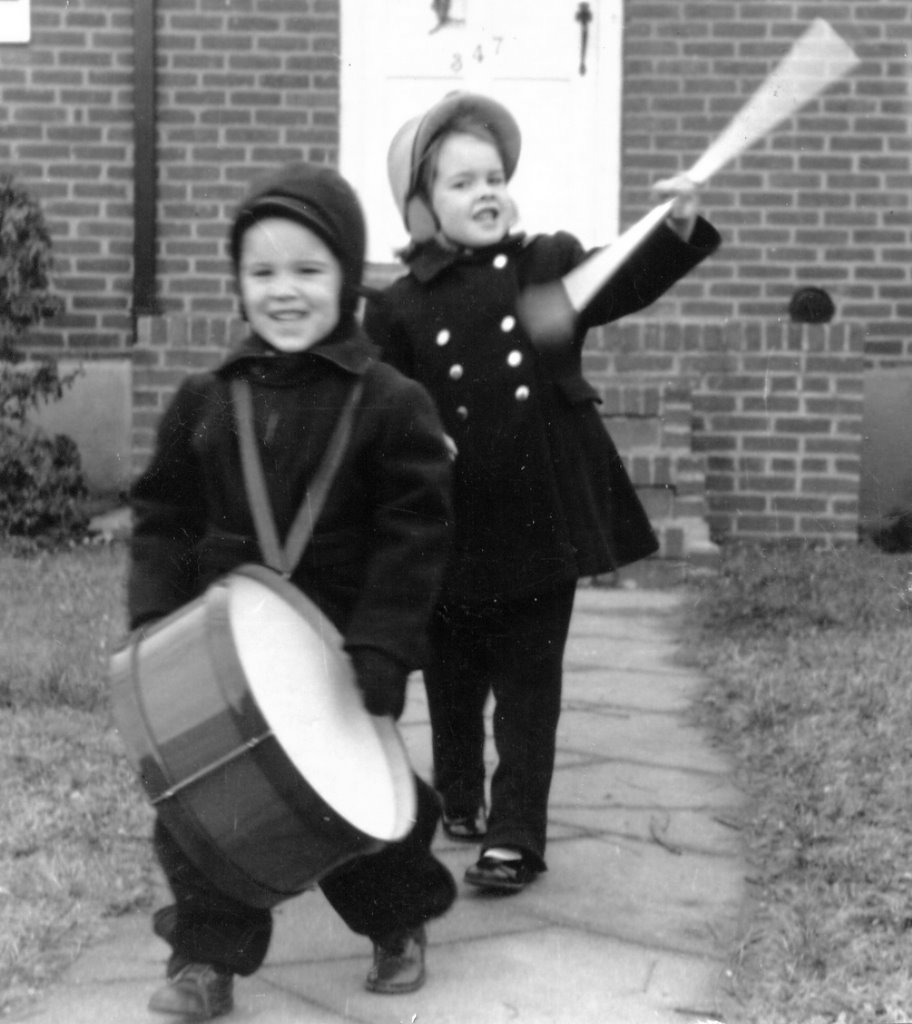
My mom and dad must have been dedicated to nurturing their children's unique gifts at whatever cost, so Santa was allowed to bring Joe a drum and me a baton. We lived in a tiny two bedroom, one bathroom, one-story house. Was Joe allowed to play the drum inside? This picture proves the falsity of Joe's accusation that I regularly beat him up. If I been a brother slayer, surely my mom and dad would not have trusted me with such an effective weapon. Richard obviously had not a fear in the world that my baton would come in contact with his head or his drum.

Joe is an amazing brother. I have always been in awe of him. Like my mom he much so much braver, bolder, eager to try new things, capable of stunningly creative mischief. I admired his becoming an altar boy when I knew Latin so much better. I admired his serving God and making a profit with wedding and funeral tips. I admired his persistence in track and cross country in high school when he never won and no one came to his meets. I admired his taking the driving test five separate times.

Joe came home from college with a trunk full of new shirts. He had been too busy gambling away his scholarship to do the laundry. Joe decided to try skiing for the first time the day before his wedding. He badly injured his knee and needed a shot of cortisone to limp his way up to the altar. The Epistle described how "my love comes leaping to me like a gazelle." I admired his courageous decision to resist induction into the army and go to jail if he didn't get conscientious objector status during the Vietnam War. I was impressed by his success at keeping his plan to refuse induction in 6 weeks a secret from his bride's family at the wedding.

Joe has fathered 6 children, been a prison librarian, ran a gas station, taught in a ghetto school, built a playground, sold coffee and ice cream, ran a chain of newspapers, been CFO of the largest US used truck company, owned an oil company, sold escalator efficiency equipment, and finally found fulfillment as CFO of his older daughter's company. He has always been a rock, supporting me and my daughters in all our trials and craziness. Sometimes his support is endless, infuriating advice. But I always know he persists in being wrong because he truly loves me.

Does Fear of Automatic Flushing Toilets Qualify as a Psychiatric Diagnosis?

The New York Times today has an interesting story on young children's fear of automatic flushing toilets. I certainly understand their fears. My daughter Rose was terrified of baths until her dad taught her the word "vortex" to explain the water draining out of the tub.

Buried in the article in this absurd statement:

Jerilyn Ross, president of the Anxiety Disorders Association of America, said that a fear of automatic toilets did not, in itself, meet the criteria for a psychiatric diagnosis. “Anxiety in and of itself is normal and healthy,” she said, “but when anxiety is excessive, irrational, and if it interferes with one’s daily life, then it may be an anxiety disorder, which is something that may need to be treated.”

Surely, some psychiatrists must question the tendency to make more and more human eccentricities and idiosyncracies grounds for psychiatric diagnosis.

11/08/2007

My Grandson

I don't usually post pictures of my grandson here because he has his own blog for family and friends. I couldn't resist sharing this picture of Michael in his new pj's. He will be six months old tomorrow. Yesterday he mastered creeping forward after creeping backward for several weeks. He is trying very hard to crawl. My daughter sometimes asks me if I love my grandson as much as I love my daughters. The answer is yes.
Posted by Picasa

11/06/2007

Are We Too Quick to Medicate Children?

The Los Angeles Times has an interesting article on "are we too quick to medicate children"? I urge you to read it.

"A study published in September found that the diagnosis among children of bipolar disorder, a mental illness long thought not to exist in kids, grew 40-fold over the last decade. The prescribing to kids of antipsychotic drugs typically used to treat the symptoms of bipolar illness have soared as well, despite continuing concerns over side effects such as weight gain, metabolic changes that can lead to diabetes, and tremors." Antipsychotic drugs, until recently, were only used to treat chronic schizophrenics.

This is what troubles me the most about the present trend:

"It has changed the way Americans think about children. Critics warn that as psychiatric diagnosis and medication of children becomes more widespread, teachers, well-meaning neighbors and relatives, and parents themselves are becoming less willing to accept youthful misfits for who they are and to help them adapt without prescribing drugs or attaching labels.

"We are suffering . . . from a shrinking tolerance for the broad limits of normality," says. Dr. Stanley Turecki, author of The Difficult Child and a practicing psychiatrist in New York and Massachusetts." There once was a time when a pocketful of well-worn adjectives, accompanied by a shrug, would have been sufficient to describe American kids at the outer reaches of normal: shy, spirited, combative, dreamy, sensitive, fretful -- even odd. All were qualities a child might readily grow out of with guidance or a few years to mature.

The descriptors for such youthful outliers have undergone a linguistic overhaul in recent years, says Ross W. Greene of Harvard Medical School's department of psychiatry. Increasingly, talk of temperamental extremes or social skills that need to be taught or strengthened has given way to the assignment of disorders, deficits and dysfunctions. Nowadays, a kid whose behavior is problematic has to have something -- a diagnosis -- which energizes school administrators, absolves parents of guilt and too often, Greene says, dictates medicating the child with powerful drugs."

10/30/2007

Third Child, Fourth Child

In this and my previous post on my two older daughters, I am concentrating on their different environments. Then I will tackle the far more fascinating question of persistent individual differences. Because I kept journals and wrote graduate school papers when Anne and Michelle were young, I tend to write less about Rose and Carolyn, my third and fourth daughters. Again, they grew up in a different world than their older sisters. By Rose's birth I was a La Leche Leader and a fervent believer in attachment parenting. Both were born at home, both nursed as toddlers, both enjoyed the family bed in infancy. Both were carried far more in the front back and back pack than their older sisters. I had developed my own mothering style; I was no longer captive to the latest book I had read.

Both had wonderful older sisters. When Rose was born, Anne was 5 and Michelle was 3 1/2. I had absolutely no worries about an older sisters' trying to hurt the baby. My only worry was that one of them would try to carry Rose around and drop her, but that never happened. By two months old, Rose loved lying on the bed and watching her sisters jump up and down. Anne and Michelle loved to make nests on the floor for Rose, and they would all play happily for a very long time. Michelle particularly spent countless hours amusing Rose. We have more pictures of Michelle with baby Rose than we do of me with all of my daughters combined.

Rose's first two years was absolutely tied to her sisters' schedules. During her infancy, I had to take her out three times a day regardless of the winter weather. Michelle went to nursery school five long city blocks away, five days a week, 9 to 12. Anne went to grade school in Soho, near the World Trade Center. Her dad took her down on the subway; I had to meet her bus on 23rd St. and 7th Avenue at 3pm every day. Getting infant Rose and tired, napless, 3 -year-old Michelle to that bus stop every afternoon was extremely stressful. I put Rose in the corduroy snugli and wrapped an old peacoat of my husband around both of us. During Rose's second year, their dad took both Anne and Michelle downtown; Michelle attended a Montessori nursery school two blocks away from Anne's school. In addition to meeting Anne's 3pm bus, I took Rose in the backpack on the subway every day to pick Michelle up at nursery school at noon.

It got easier the year Rose was 2 and Michelle had joined Anne in grade school. I only had to do the 3 PM bus pickup. Several days a week Rose went to a toddler playgroup a block away. Rose was traumatized by the move to Maine when she was 2 1/2. Before we bought our house in Bangor, we rented an apartment in Hamden Highlands; we had a frog pond right next to the house. I quickly found a playgroup for Rose, and she was excited about the first meeting. We got out of the car and were quickly led into the barn with a cow, horse, pig, and ducks. Rose was hysterical. Playgroup was supposed to involve elevators, not barn animals.

Our lives had changed dramatically when Carolyn was born in 1982. We lived in a house, not in a high rise; we owned a car for the first time. Both Carolyn and Rose spent lots of time at Anne's and Michelle's school. Skitikuk, a unique school for 45 children 5 to 18, was in a old barnhouse, with abundant fields around; they even had ducks and three horses. I taught a baby development class with Carolyn as the experiment. We always went to the weekly talent shows. I found a playgroup for Rose without horses, and she went to nursery school three days a week when she was 4.

When we moved back to Long Island, Rose was 5 and Carolyn was 17 months. Thankfully, the grade school was a block and a half from our house. Carolyn went to playgroups until she was 3, nursery school 2 mornings a week when she was 4, and 3 mornings when she was 4. She saw her grandparents at least three or four times a week. Carolyn had adoring, doting older sisters until she got to be about 5, and everyone discovered how much fun it was to tease her. She was an incredibly good loser, so she was welcomed to play games with her sisters by the time she was 4. From kindergarten to senior year, any teachers who had all four of them found Carolyn the most delightful, the friendliest, the best adjusted.

Grandmotherly Advice to My Younger Self

For the last few days, I have been rereading a journal I kept in 1976-1977 and sharing my absurd mistakes with you. This is a post advising my younger self on apartment living with young children.
  • Do not leave a three-bedroom Manhattan apartment costing $350 a month and move to Bangor, Maine, 450 miles away from grandparents who are now 20 miles away.
  • It is not possible to recreate a childhood 60 feet by 270 feet backyard on a 6 by 46 feet terrace on the 20th floor.
  • Take them to grandma's house more often, where they can climb trees, play softball, play volleyball, learn croquet, learn to garden.
  • Forget about the terrace sandbox. The terrace is not the beach.There is a sandbox playground right outside the house. Sand in the house is unbearable. Visit grandma and take them to Jones Beach.
  • Keep the swimming pool but detach the hose once it is filled up. By the time they figure out how to attach it, they might be less interested in watering hapless victims 20 stories below.
  • Confine messy art projects involving glue, finger paints, tempera paints, play dough to kitchen or terrace. Buy somewhat fewer art supplies ; I don't need enough adequate for a nursery school.
  • Buy fewer toys and concentrate on sharing toys.
  • Get outside every single day when the temperature is above freezing and maybe even then. Children love snow, rain, wind, fog.
  • Be firmer about naptime and bedtime.
  • Use babysitters more. Take advantage of grandparents' offers for weekend breaks.
  • Continue part-time editing, if only a few hours a week.
  • Only do housework, cooking, laundry, shopping when the kids are awake and involve them from the time they are 1.
  • Try harder to confine food to kitchen and terrace. Accept I will not always succeed..
  • Do not take toddlers to playgroup five days a week.
  • Try harder to contain smaller toys like legos, blocks, little people, doll furniture, puzzles in the playroom.
  • Respect my limits. Don't try to be mother of the year. Know when to say enough.
  • Most importantly, make more time for us as a couple. Always putting the children first gradually eroded our marriage and laid the seeds of the divorce, which was infinitely more traumatic for the kids than if we had left them more.

10/29/2007

First Child, Second Child


This is from a graduate school paper on child development I wrote in 1977, when Anne was 4 and Michelle was 2.
I am still realizing to what extent the mother I am is shaped by the child I am mothering. When I had only one child, I congratulated myself for all of Anne's superior qualities and blamed myself for her troublesome ones. Since I've had 2 children, I've become remarkably more tolerant of other mothers and of myself. I've also grown to understand why my my mom, after mothering 6 kids, has always been quite skeptical of childrearing theories. Since I belong to a community where young parents try to help each other through babysitting cooperatives, cooperative playgroups and nursery schools, and mothers' support groups, I've had the chance to observe many children of similar ages interact with their parents. When I first moved here when Anne was 17 months, I was quick to correlate the children's characteristics with their parents' childrearing practices. Now I am humbly aware of how infinitely complex the whole question is.

The only dramatic change in our lives beween Anne's and Michelle's births was our move to Chelsea from the Upper West Side. We still lived on a high floor in an apartment with a terrace and spectacular views. But although I was still at home full-time and their dad was gone from 8 to 6, their day-to-day routine was completely different. When Anne was born, none of my NYC friends had children; consequently no one I knew was home during the day. To relieve my isolation, I frequently visited my parents and my husband's parents on Long Island. As a result, Vanessa had frequent contact with her grandparents and her teenage aunts and uncles, but very little contact with other babies and toddlers. When Michelle was born, I was immersed in Anne's playgroup, with daily contact with 10 familes and their 2-year-olds. Monday to Friday Michelle was constantly exposed to the stimulation-bedlam of young kids. In fact playing with baby Michelle was playgroup's surefire activity when all else failed. On the other hand, I seldom visited Long Island; our parents and sibs came to visit us. Michelle's comings and goings are always tied to Anne's schedules.

In addition to having different daily routines, they had a rather different mother. After Anne's birth, I still did some free-lance editing. I kept wrestling with the question of if and how and when to combine motherhood with my editing career. By the time Michelle was born, I had wholeheartedly renounced publishing and was fully committed to full-time motherhood when my children were small and had chosen working with young children as my future career. My expectations for myself and my baby had been transformed by what I experienced and by how I had grown during Anne's infancy. I was far freer to respond to my emotions and intuitions about Michelle. I had gained confidence in my own style of mothering and was so longer so swayed by "expert" opinion or my prior expectations of what kind of mother I should be. I was much more relaxed about introducing solids, long-term nursing, the family bed.

Michelle's relationship with me was hardly as symbiotic as my relationship with Anne during infancy. Anne was as much as part of Michelle's life as my husband and I were. Unless Anne was asleep she was almost always in the same room when I nursed or played with Michelle. As soon as Michelle could reliably sit up, we bathed them together. Since Michelle was 8 months old, they've amicably shared the same room. I successfully diminished Anne's jealousy by involving her in every way possible in Michelle's care. I always read to Anne when I was nursing Michelle since she hated playing in her bedroom by herself.

The result? Michelle's social skills seem far more sophisticated than Anne's were at 2. Sometimes she stays at Anne's cooperative nursery school when I am the helping mommy. She knows all the children's names, interacts warmly with them, participates fully in painting, block building, clay, water play, and dress up and manages surprising well at meeting time and story time. She needs to establish eye contact with me fairly often, but she leaves me free to interact with the other children. At home she holds her own with her high-powered sister very well. As I observe her avoiding no-win confrontations with Anne, I try to imitate her skillful mixture of unmistakable self-assertion and judicious compromise. As Michelle chortles, "even Anne loves me."

Favey


This post needs to be read after reading the earlier one on inconsistency. When I forbade Anne to bring her blanket to the playground, I forgot to add, "And you can't bring it to Niger when you are 28 either." This essay was part of Anne's grad school application to Columbia's School of International Affairs, which accepted her. Reading this should bring comfort to all of you who are learning how clueless I was in the early years as Anne's mother. Our children are far easier on us than we are on ourselves.

You are to be photographed with one of your personal belongings. What is the object and why did you select it? Three days after I was born, my father’s mother presented my nervous new parents with a gift: a baby blanket. Loosely woven out of fuzzy white acrylic yarn, interspersed with strands of pale blue, pink, and yellow, and bordered with a satin ribbon, it soon became a permanent fixture in my crib. The earliest black and white photographs taken of me–so early that my newborn legs had not yet uncurled–feature the blanket. There is a photograph, a favorite of my father’s, that shows an infant Anne just learning to hold her head up, sprawled on the blanket with a fledgling copy of Ms. magazine propped over her back.

When I learned to speak, I started calling the blanket “Favey,” a name that baffled my parents until they realized that it was two-year old shorthand for “favorite blanket.” My parents, I now realize, were unusually accepting of security blankets and dependency needs in general. When I was four, there was a famous incident at a dance recital when the teacher refused to let me perform in front of the parents with my blanket. My mother defended me, and I sat out the show. The teacher prophetically warned my mother that I would “make mincemeat” out of her. I prefer to think Anne eroded the old self and help me grow a much more understanding, gentler one. She was not entirely wrong, but I soon learned that there were negotiations in store when I grew older about where it was and was not acceptable to bring Favey: the New York City Ballet was out, but the babysitter’s house was perfectly fine.

I hung on to Favey long after the point that most children give up their security blankets. The blanket suffered its share of wear and tear over the years–the satin border disintegrated, the colored stripes faded, and, most horrifically, my little sister cut a strip out of it to get back at me after a fight–but it stood up remarkably well. It became a standing family joke that I would bring Favey to college. Of course, as I grew older, I developed new and revealing uses for my blanket: I started sleeping with it over my eyes in order to block out the light that I was too lazy to turn off when I had fallen asleep reading in bed; in junior high, I tied it around my wet hair when I went to sleep so that it would be manageable in the morning.

I outgrew these uses for the blanket, but I never seemed to outgrow the blanket itself. When I started college, Favey came with me. I didn’t always sleep with it, but it was always there. It became the only superstition of my life: getting rid of it seemed equivalent to changing your routine when you’re on a batting streak. When I finished college and started traveling around the world as a cost of living surveyor, I brought it with me for good luck, even if I didn’t always remember to unpack it from the suitcase. One of my favorite moments of surveying came when I returned to my hotel room in Hong Kong after a long day only to find that the hotel maid had artfully draped my tattered blanket across the pillow with a mint. When I packed my bags to spend the year in Niger, the blanket came with me. At some point it will need to be retired before it disintegrates completely. I would like to preserve it and hand it down to my own daughter some day.

I have had the opportunity to do amazing things in my life. I have seen some of the truly wondrous places in the world, from the Sahara desert, to Machu Picchu, to the Mekong River Delta. I have jumped out of a plane in Maine and been seventy feet underwater in the Caribbean. I have witnessed one of the poorest countries on earth usher in a new era of hope and democracy. I hope to have a long life in which to add to this list of memories and accomplishments. But ultimately, I believe it is the quality of the love we have shared with others by which our lives should be measured. I can think of no better witnesses to my life than my family–mother, father, three sisters, grandparents, aunts, uncles, and cousins too numerous to count

I love and admire my family for more reasons than I could possibly enumerate on this page. They have always been the most important part of my life: the context in which I first began to define myself as well as my safe haven. That one shredded bundle of acrylic yarn, more gray now than white, is a repository for my memories and a reminder of where I came from. My parents, who respected and trusted a child enough to let her hold on to a security blanket long after others thought she had outgrown it, gave me a valuable gift. I learned from an early age that my own judgment could be trusted, and the confidence that this trust brings has granted me the freedom to strike off in directions that others fear.

Favey at the moment rests at my house. Apparently, now that she is a mother, Anne doesn't need favey. Perhaps she thinks it is a better favey for a daughter. Amusingly, my grandson seems to be getting attached to a burp rag, and everyone is trying very hard to convince Michael to get attached to an adorable light green textured bacon and eggs blanket. My family is taking the question very seriously. Michelle argues that a hotel maid in Hong Kong might be appalled by a 27-year-old burp cloth and Michael will be deprived of his mint.

Inconsistency, September 25, 1976

Reading and posting these entries from 30 years ago is a humbling experience. I feel guilty about how hard I was on Anne, how unreasonable my expectations were. I am going to post Anne's essay on her blanket, written for graduate school in international affairs, so you will know how the story eventually turned out. My other daughters had a far better mother than Anne did; they should be grateful to her for teaching me what battles are worth fighting.

How are my new rules working? Anne dressed herself, but only because she had insisted putting on the clothes she selected for today before she went to bed. She requested oatmeal for breakfast because John had it and then age about 3 spoonfuls. Just as we were leaving, she hit me and I yelled at her. She cried and insisted on taking her bear and blanket to the playground. Then I made the classic mistake and laid down a rule without thinking. I said, "You can't take the blanket outside. It's only for naps. You get it too dirty dragging it everywhere." I closed the apartment door, and she continued to cry. Finally, Anne said, "I need my blanket because it will make me feel better." I was touched and admitted I had made a mistake. She could have her blanket when she wanted to. She could be the blanket boss. The only reason I didn't want her to have the blanket is because I feel embarrassed she is still so attached to it. Far better if I had thought things through before I stated an ultimatum, then revoked it. Such inconsistency teaches her that crying and carrying on works.

10/28/2007

My Girls Were Just An Excuse


Every woman needs at least one friend whose house is a bigger disaster than theirs. I am proud to say I have always been that woman for my friends. When my husband and I are alone in the house, we thrive in our mess since our priorities are perfectly compatible. The crisis occurs with my daughters before the new boyfriend becomes the husband. Then I am expected to indulge in a mad frenzy of cleaning so he won't realize until the ring is on his finger what genes his children will inherit.

The Recipe


When people compliment me on my four grown daughters, I laugh: "I know the recipe, but no one would ever follow it." Looking back, I appreciate how absurd we were, but on the other hand, the results of our insane experiment in creative childrearing have been gratifying. All three husbands and one live-in boyfriend come from much neater homes, so it will be fascinating to see how my grandchildren are raised.

Setting Limits with a 4 Year Old


Terrace on the 20th Floor
We lived on the 20th floor of an apartment building on West 28th Street, in Manhattan. We had a terrace that was 46 feet by 6 feet with gorgeous view sof the Hudson River. On the terrace was a kiddy pool, a sand table, a large table for arts and crafts and birthday parties. The terrace had a hose and a drain. The terrace below ours was 46 feet by 12 feet so things thrown off the terrace would likely land on our downstairs neighbor's terrace. I was so thankful our building had odd and even elevators so I never had to meet this unfortunate woman in the elevator. If the kids pointed the hose over the north side of the terrace, they could water pedestrians 20 stories below. They were allowed to blow bubbles and chalk the side of our apartment. We were certifiably crazy, but everyone loved to play at our apartment. Anne, who lives in the same apartment complex, plans to get on the waiting list for this particular apartment.

A day like today convinces me that we have not expected enough of Anne. In many ways she is no easier to manage than she was 14 months ago. I have totally failed to set consistent limits. She has been allowed to do what she wants around the house; we have not expected her to follow any rules to kept the house from becoming intolerably chaotic. I have continually lowered my already low housekeeping standards to tolerate toys in every room, discarded clothing everywhere, sand everywhere, liquids spilled over rugs, chairs, and beds, crumbs underfoot, the terrace resembling a slum. All so Anne won't be repressed, so her creativity won't be reined in by artificial standards of order.

I read too many psychoanalysts on the subject of child care and not enough learning theorists or teachers. Undoubtedly, I misinterpreted what I read about setting limits. It probably never occurred to any of these gentlemen that any woman would be as lax and accepting as I am. Their strictures were appropriate for a compulsive housekeeper. No one advocated turning your living room into the beach.

I sit surrounded by the shambles of our living room. I laid down a whole set of terrace rules for Anne at the dinner table in my worst lecture-room fashion. I know such harangues make little impression on her. Just now she told me to "stop ruining her by talking to me."
If she can't follow the terrace rules, she comes right inside.
  • No one except me empties the pool
  • Absolutely nothing gets thrown off the terrace.
  • The hose can only be used to fill up the pool, not to water the ground or the terrace below.
  • She can only pour water over her own head
  • No sand in the swimming pool
  • No forcing Michelle to swim
  • Only a reasonable amount of water in the sand table
  • Sand and water stay around the sandbox and pool; they don't go beyond the card table
  • No sand in the apartment
  • Turn off the hose when I say so
  • Help sweep up sand. Buy her a broom and dustpan
Did I succeed in enforcing these rules? Once the pool blew away, but that wasn't Anne's fault. Two years later we moved to a three-bedroom apartment without a terrace, and my mom took the pool and the sandbox. However, the living room was now the playroom, complete with a tent, a six foot blackboard, hundreds of blocks, and hooks in the ceiling for a swing, rings, and a trapeze. We used one of the bedrooms as a living room. Two years after that we moved to Bangor, Maine, and finally had a backyard.